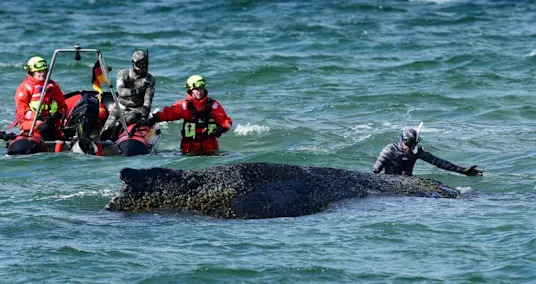
A humpback whale struggling in shallow waters off Germany's northern Baltic Sea coast has become stranded for a third time, experts said on Sunday, just hours after the animal had freed itself from a sandbank.
The 13.5-metre (44-foot) long mammal was first spotted in the early hours of Monday on a sandbank near the city of Luebeck. It managed to free itself on Friday after a mechanical digger set up an escape route.
However, it has run into fresh difficulty after swimming further east.
After escaping a second sandbank late Saturday near Wismar, it was stranded once again on Sunday.
"The prognosis as a whole doesn't look good," marine scientist Burkard Baschek told reporters on Sunday after conducting an assessment at the scene.
Scientists say the whale's breathing frequency has reduced and that it is no longer exhibiting reactions to nearby vessels.
For the moment no further rescue actions are planned but the government of the German state of Mecklenburg-Western Pomerania say there are also no plans to euthanise the whale.
Experts still held out some hope that the animal may free itself again after gathering enough strength.
However Baschek warned that its health had "considerably deteriorated" and that the risk of it becoming stranded yet again was high.
Experts had hoped the whale would return to its natural habitat in the Atlantic through the North Sea.
Humpbacks are rarely seen in the Baltic and the experts said it may have been following a shoal of fish or been distracted by the noise of a submarine.
lep-jsk/rmb
LATEST POSTS


 NAFFIC, AWARE claim first China-EU DPP for textiles
- The 15 Most Compelling Books in History
- Germany unveils rescue plan for struggling chemical sector
- Grass Care Administrations for a Wonderful, Sound Yard
- Doctor's orders: Eat ice cream, and other tips for a long and healthy life
- Munich Security Conference chief defends inviting AfD lawmakers
- Innovative Versatility: Examples of overcoming adversity from Entrepreneurs
- At least 7 dead as Israel renews attacks on Beirut and across Lebanon
- As cases of a rare, deadly infection rise, doctors worry fewer teens will get vaccinated