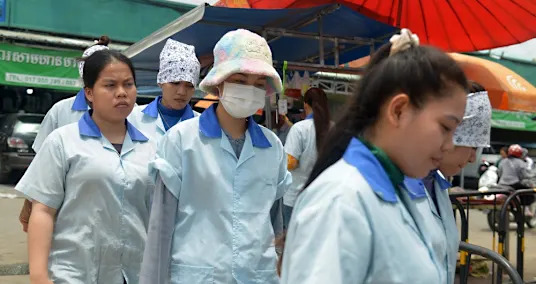
Sarah Krassley, a visiting fellow at Cornell University’s ILR School, was midway through a tour of a garment manufacturer in Cambodia when a question occurred to her. She gestured to the evaporative cooling “water curtains” lining the factory walls, the exhaust fans driving cold air across sewing floors, the refrigerant-powered air conditioning keeping heat‑sensitive equipment thrumming despite summer temperatures that have soared past 42 degrees Celsius, or 107.6 degrees Fahrenheit.
“Did a brand help you pay for this? Did the International Finance Corporation or another development organization?” she asked the women leaders of Sabrina Garments, a nearly 78,000-square-foot facility on the western edge of Phnom Penh in Kampong Speu Province. “They looked at me like I was nuts. They were like, ‘No, we funded this ourselves. Why would we do otherwise?’”
More from Sourcing Journal
Krassley was on a research trip in Cambodia and Vietnam in November, where—as she wrote in a report published by the ILR Global Labor Institute a few months later—extreme heat waves intensified by climate change have become not a “passing disruption” but a “defining operating condition” that can cause physiological heat strain, leading to exhaustion, vision loss, urinary tract infections or even death.
As founder of Shimmy Technologies, an AI-powered gamified training platform that helps upskill garment workers for the age of automation, Krassley has long been interested in what happens when large forces collide with worker livelihoods. Now she wanted to understand how apparel factories were adapting to what she described as heat’s “systems-level pressure on labor,” especially as suppliers on razor-thin margins bear the cost in poorer countries where aging infrastructure is expensive to retrofit and well-intentioned buyer codes of conduct seldom translate into financing.
The ILR Global Labor Institute had already made the business case for climate adaptation in a series of reports, beginning with a 2023 analysis with the investment firm Schroders that estimated that declining productivity from mounting temperatures and flooding could cut export earnings by $65 billion and jeopardize 1 million new jobs in four of the world’s top garment-producing countries by 2030. Its research also found that workers had few safety guidelines and even less legal recourse when conditions became unbearable.
Most of all, it concluded that adaptation isn’t yet built into risk planning because the broader fashion industry, as well as the regulators meant to deliver oversight, remain laser-focused on mitigation.
“A lot of people who care about what’s going on in workers’ lives are struggling to capture the impacts, or quantify them,” said Jason Judd, executive director of the ILR Global Labor Institute and an author of many of the previous studies.
To document real-world examples of largely self-financed heat adaptation measures initiated by factory management, Krassley visited An Giang Samho, a large semi-automated footwear complex in Vietnam’s An Giang Province; WorldOn, a cut-and-sew facility about 90 minutes outside Ho Chi Minh City; and the aforementioned Sabrina Garments in Cambodia.
What she discovered were three distinct adaptation pathways: the first introduced gradual changes within an open-shed set-up that relied on natural cross ventilation; the second saw cooling as necessary for the precise temperature and humidity control required to run automated technologies like robotic sewing; and the third made incremental investments guided by data and worker feedback. While their methods differed, one thing united them: all three manufacturers treated cooling not as a reactive response but as essential to their long-term operational resilience. The result also justified these improvements.
“The factories that have invested proactively are seeing an ROI beyond straight-up ‘we’re more productive,’” Krassley said. “There were broader returns. And it was interesting to see what was important to workers.”
At Sabrina Garments, for example, absenteeism hovers at 1 percent, a rarity for Cambodia’s garment sector, managers said. Coupled with competitive salaries, subsidized lunches and what she characterized as a “calm, respectful environment,” workers are clamoring for jobs at the factory. Employees also reportedly remain with Sabrina Garments for 10 to 15 years in an industry plagued by high turnover, many of them returning after family leave.
Something else Krassley observed was that the factories didn’t embark on one gigantic, expensive retrofit, but rather took a stepwise approach to accumulating cooling improvements that was easier on their bottom lines.
They didn’t have to be expensive, either: An Giang Samho installed ice machines to make and store clean ice after a manager noticed workers bending over makeshift ice buckets filled with often unsanitary ice from their neighborhoods. When workers started using them, supervisors reported fewer midday heat complaints. A union leader Krassley spoke to also described the decision as “meaningful,” an indication of management attention and a “gesture of care beyond mitigating a compliance risk.”
At the same time, the factory’s “most consequential” climate adaptation, she said, came from a vendor-financed solar installation whose financing structure allowed it to adopt renewable energy without upfront capital or downtime. Functioning as a thermal shield that catches heat from the sun before it warms the building, the solar panels have helped lower indoor temperatures by 3 degrees Celsius while reducing energy costs by $3,000 per month.
While WorldOn purpose-built part of its factory with air conditioning—uncommon in Vietnam—it too made progressive decisions that alleviated heat discomfort, such as replacing steam-based ironing systems and fabric-relaxing machines with electric ones that lowered ambient temperatures. Instead of conventional metal ductwork, it employed fabric-based air dispersion ducts that are easier to clean and distribute air more evenly without creating drafts.
WorldOn also moved from passive ventilation to active environmental management by installing a digital monitoring system that uses sensors to track temperature and humidity throughout the factory, keeping levels within defined parameters during production hours.
For Krassley, these case studies show there’s a “real opportunity” to tackle climate adaptation meaningfully by prioritizing progress over perfection.
“None of these is a fully complete solution to heat abatement,” she said. “But it builds on the next and builds on the next and builds on the next. And with the world we’re in right now, that’s the type of action we want to encourage. We don’t want a factory to throw up its hands and say, ‘Well, this is too expensive. I can’t go all in on cooling.’ We want them to say, ‘OK, what are these things I can do with a target in mind?’”
Krassley sees a clear parallel between the industry’s reaction to the 2013 collapse of Rana Plaza in Bangladesh and how it needs to respond to the worsening worker heat crisis. After the tragedy happened, fashion brands and civil society organizations rallied to evaluate and repair safety shortfalls that threatened similar buildings and the workers within them, even if they required massive capital investment. Heat, she said, must now be met with the same sense of urgency.
“If we don’t get a handle on this in terms of heat, we’re going to be in that same situation,” Krassley added. “It might not be buildings coming down, but people are already suffering.”
LATEST POSTS
- 1
 Figure out How to Explore the Infotainment Framework in the Slam 1500.
 - 2A red meat allergy from tick bites is spreading – and the lone star tick isn’t the only alpha-gal carrier to worry about
- 3Lecturer who called Israel a terrorist state to remain Plaid Cymru candidate
- 4Qantas and Virgin Australia Ban Power Bank Usage on Flights Following Safety Incidents
- 5Vote In favor of Your Favored Shades





- As infant botulism cases climb to 31, recalled ByHeart baby formula is still on some store shelves
- Grass Care Administrations for a Wonderful, Sound Yard
- Eli Lilly to build $6 billion Alabama plant as part of US manufacturing push
- Experiences in Natural life Protection: Individual Progressives' Excursions
- Kona SUV: Exploring the Future with Hyundai's Visionary Hybrid
- Why this Tennessee special election has the 'whole world' watching
- Russian drone slams into block of flats in deadly wave of strikes across Kyiv
- 6 U.S. States for Climbing
- Vote In favor of Your Favored Kind Of Attire


