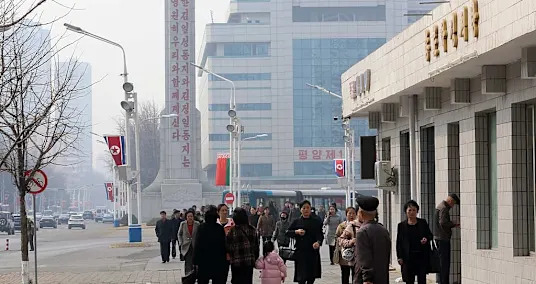
China has announced that its flag carrier, Air China, will resume direct flights to North Korea after a six-year pause, following the restoration of passenger train services between Beijing and Pyongyang.
This marks a significant step toward reopening North Korea, one of the world's most isolated nations, to the world.
Transport links between the two capitals had been suspended since the start of the Covid-19 pandemic in 2020, when Pyongyang implemented a very strict border closure.
While North Korean carrier Air Koryo already resumed flights to Beijing in 2023 and allowed Russian tour groups to visit in 2024, the return of China's air and railways are seen as a major economic milestone, as China has for decades been the main trading partner and a key source of diplomatic and economic backing for the country of 26 million people.
Before the pandemic, there were an estimated 300,000 foreign visitors in 2019, according to South Korea's Institute for International Economic Policy, and Chinese visitors accounted for 90% of all tourists to North Korea. Therefore, the long delay in resuming regular travel had surprised many regional observers.
"The reopening of these borders has been driven primarily by Pyongyang's timeline, which challenges the outdated assumption that Beijing dictates terms to a dependent client state," Seong-Hyon Lee, a visiting scholar at the Harvard University Asia Centre, explains.
Related
Nuclear ambitions complicated the relationship
Despite being Pyongyang’s primary ally, Beijing has frequently voiced disapproval over the North's persistent missile tests and nuclear ambitions. This aspect created a bumpy relationship with Pyongyang, with analysts saying that a nuclear-armed North Korea has often been something of a liability.
The diplomatic normalisation was highlighted last September, when Kim Jong Un attended a massive military parade in Beijing alongside Russian President Vladimir Putin. This was Kim's first appearance at a Chinese military display.
Lim Eul-chul, a North Korea expert at South Korea's Kyungnam University, argues that the war in Iran, in particular, increased "the need for closer coordination between the two nations".
LATEST POSTS
- 1
 Step by step instructions to Guarantee Your Fender bender Legal counselor has Areas of strength for a Record
 - 2ISS astronaut snaps stunning nighttime photo of Florida and Cuba | Space photo of the day for Dec. 29, 2025
- 3Kiev declares energy emergency after Russian attacks amid winter cold
- 4Vaccine makers raise concerns over US panel's shift away from hepatitis B shots for newborns
- 5Administrative building in Sharjah region targeted by Iranian drone, UAE authorities announce


- The newest 'Project Hail Mary' trailer shows Ryan Gosling befriending an alien in Phil Lord and Chris Miller's space epic
- The Main 20 Photography Instagram Records to Follow
- Latvia seeks emergency UN meeting over Russian missile attack on Lviv
- Old video misrepresented as senior Sri Lankan ruling party member criticising president over fuel shortage
- 'Supergirl' drops 1st teaser trailer: Watch Milly Alcock as Kara Zor-El and the return of Krypto the Superdog
- Satellite constellations could obscure most space telescope observations by late 2030s: 'That part of the image will be forever lost'
- Eli Lilly to build $6 billion Alabama plant as part of US manufacturing push
- As cases of a rare, deadly infection rise, doctors worry fewer teens will get vaccinated
- A new mom skipped a routine appointment. An infected cut led to a devastating diagnosis